The Process1st Business Process Modeling Framework
The Process1st Business Process Modeling Framework consists of a well-defined, logically-integrated set of documents that offers a thorough, complete, accurate, precise, multi-dimensional model of a business process. It supports the needs of every stakeholder involved in the development, performance, management, measurement, and improvement of business processes.
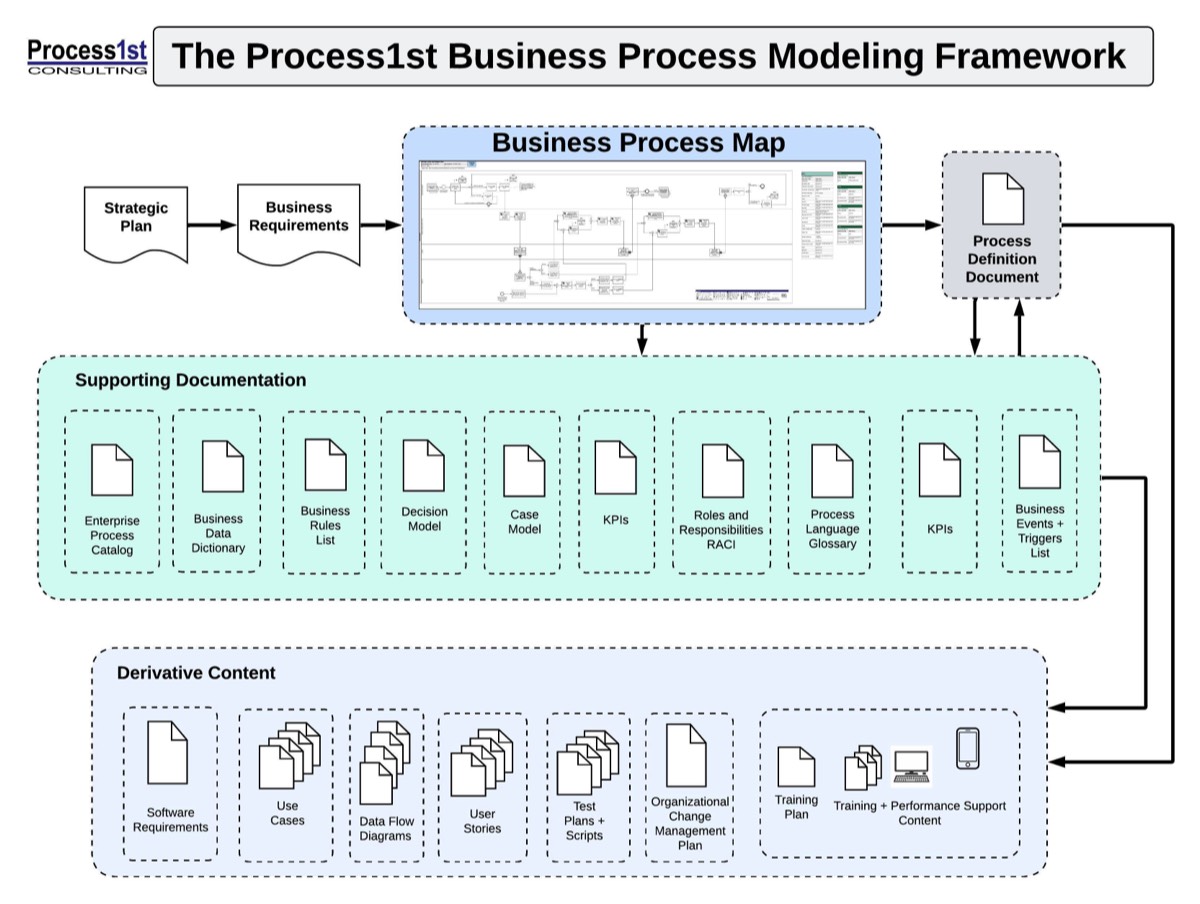
The Business Process Map
In the Process1st Business Process Mapping, Documentation, and Analysis methodology, the BPMN business process map is the foundational or "base" document in a comprehensive set of business process documentation because it serves as the master blueprint for everything else.
The business process map is foundational because it defines scope, structure, and relationships before any detailed content is written. It reduces ambiguity, ensures alignment across the organization, minimizes duplication or gaps in documentation, and provides a single source of truth from which all other process artifacts are derived and maintained.
The business process map is foundational because it defines scope, structure, and relationships before any detailed content is written. It reduces ambiguity, ensures alignment across the organization, minimizes duplication or gaps in documentation, and provides a single source of truth from which all other process artifacts are derived and maintained.
The Business Process Classification Framework
A business can be defined as a system of processes. The Business Process Classification Framework (PCF) is a structured, hierarchical categorization of all the processes in a business organization. It organizes processes into high-level categories (e.g., Operating Processes, Management & Support Processes) and then breaks them down into increasingly granular levels (process groups → processes → activities).
The Business Data Dictionary
A Business Data Dictionary is a list of all of the data objects involved in a business process.
Business Data Object Elements:
- The Title of the Data Object (using a consistent data object naming convention)
- A brief description and definition of the Data Object
- Each Data Object Property (i.e. field)
- Description/Definition of each Data Objects Property
- Source Data Object (if this field's data is sourced from another Data Object)
- Multi-value? (if the field can contain multiple values)
- Acceptable Values (data entry control: range, format, conditional, restricted, required, etc.)
The Process Definition Document
The Process Definition Document (PDD) includes specific sections such as:
- Definition and Purpose of the Process
- Process Goal and Objectives
- Inputs and Outputs
- Resources (Capital, Equipment, and Human)
- Process Roles and Responsibilities
- Initating Business Events (Process "Triggers")
- Process Sequence (Process Narrative)
- Process Rules (Business Rules)
- Process Measurements
- Process Controls
- High-Level Process Diagram
- Validation (Process Owner and Stakeholder Acknowledgement and Agreement)
- Process Issues and Risks
- Outstanding Questions and Issues (with detailed Action Items and Statuses)
Most of the time, this is an “all or nothing” document. The extent of detail in this document covers a lot of significant information about both the design and the management and control of a process. On projects requiring only a minimum amount of documentation, the PDD and a procedural-level BPMN flowchart might be the only two types of documentation we deliver
The Process Language Glossary
People often communicate using real or made-up acronyms, slang, generalizations, and
misnomers. This causes plenty of confusion. The Process Language Glossary is intended to
serve as THE definitive source of process language, terms, and acronyms. If nothing else, it’s
used to clarify and confirm all process stakeholders’ understanding of the organization’s
“language of process.”
misnomers. This causes plenty of confusion. The Process Language Glossary is intended to
serve as THE definitive source of process language, terms, and acronyms. If nothing else, it’s
used to clarify and confirm all process stakeholders’ understanding of the organization’s
“language of process.”
Additional Documentation Included in the Process1st Business Process Documentation Model
- Business Rules List
- Decision Model
- Case Model
- RACI Matrix
- Metrics/KPIs List
- Software Requirements
- Use Cases
- Agile Epics, Themes, Stories
- Testing Plans and Scripts
- Organizational Change Management Plans
- Training Plans and Courses
- Process Implementation Plans
- Employee Performance Appraisals
- Incentive Compensation Management Plans
Contact Process1st today
for more information.